

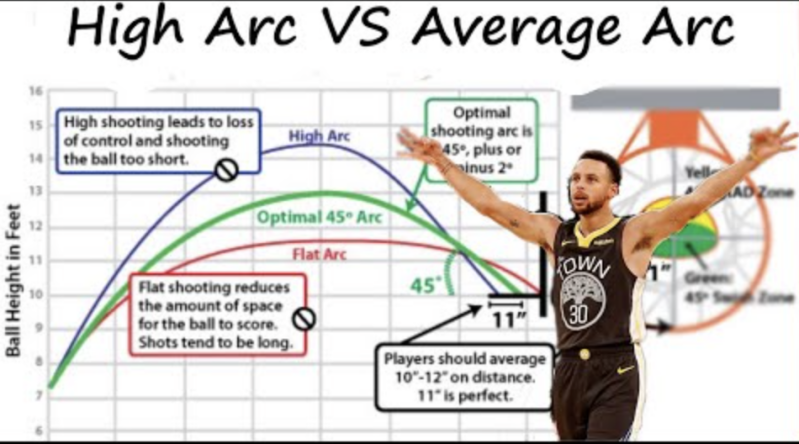
When we conduct shooting sessions at Performance 33, we teach several things about positioning, form, and motion. Of the shooting aspects we teach, there are two components we stress: the ideal arc of the ball's flight path and the importance of backspin. We stress the importance of arc and backspin because they are components that most players don't think much about and probably don't understand why they matter. In this post, we'll explore the science behind what we teach. We'll begin with arc.
Arc
An arc of approximately 45 degrees is considered the ideal angle for shooting a basketball because it combines physics, geometry, and human biomechanics to maximize the chances of the ball going through the hoop. While every player has a unique shooting style, research and practical experience in basketball have consistently shown that shots with a moderate-to-high arc provide the greatest margin for error and improve shooting accuracy.
One of the primary reasons a 45-degree arc is effective is that it enlarges the apparent size of the basket. When the basketball approaches the rim at a shallower angle (flat), the hoop opening appears smaller because the ball is moving more horizontally than vertically. A low-arc shot has less room for error because the ball must travel through a narrower “entry window.” However, when the ball approaches the rim at roughly a 45-degree angle, the hoop appears larger to the incoming ball. This creates a greater margin for slight mistakes in aim, speed, or release point.
In many projectile situations, a launch angle near 45 degrees yields an efficient combination of height and distance. In basketball, this balance is important because the shooter needs enough height for the ball to clear defenders while still maintaining forward momentum toward the basket. A shot with too little arc may strike the front rim because it travels too directly. A shot with too much arc, on the other hand, can lose power and become difficult to control consistently. Around 45 degrees provides a balanced trajectory that allows the ball to descend softly toward the hoop.
A softer landing is another important advantage of a higher arc. As the ball descends more vertically, it is less likely to ricochet hard off the rim or backboard. Instead, the ball tends to absorb impact and “die” softly near the basket. This softness increases the likelihood of favorable bounces and friendly rim rolls. Backspin enhances this effect even further by slowing the ball’s rebound off the rim or glass. Many great shooters intentionally combine proper arc with consistent backspin to create a shot that is forgiving even when it is not perfectly centered.
Backspin
Backspin is a critical component of accurate shooting because it helps control the ball’s speed and reaction after contact with the rim or backboard. When a player releases the basketball correctly, the fingertips create a backward rotation on the ball, typically producing two to three rotations before the ball reaches the basket. This backward spin acts almost like a braking system. If the shot hits the rim or backboard, the backspin reduces the force of the rebound and causes the ball to bounce more softly rather than ricocheting away. This softer contact increases the likelihood of “friendly” bounces that still result in made baskets. Backspin also helps stabilize the basketball's flight through the air, creating a smoother and more predictable trajectory. Proper follow-through — often described as “reaching into the cookie jar” or holding a “gooseneck” finish — naturally produces the backspin needed for touch and consistency.
Mathematics also supports the effectiveness of a roughly 45-degree shot. Researchers studying shooting percentages have found that successful shooters commonly release the ball at approximately 44 to 52 degrees, depending on distance and player height. A shot near this range optimizes the entry angle into the basket. The ideal entry angle into the rim is generally considered to be around 45 degrees because it maximizes the hoop's usable opening. A steeper descent allows the ball more space to pass through cleanly.
Biomechanics play a role as well. A natural shooting motion often produces an arc close to 45 degrees when the legs, hips, shoulders, elbow, wrist, and follow-through are properly aligned. Shooting with this type of arc encourages players to use their legs and whole body rather than relying solely on arm strength. This creates a smoother, more repeatable motion that can withstand pressure and fatigue. Coaches frequently teach players to “shoot up” rather than “shoot out,” helping athletes create lift and arc naturally through good mechanics.
The success of elite shooters provides practical evidence of the importance of arc. Players such as Stephen Curry and Ray Allen are known not only for accuracy, but also for the high, soft arc on their jump shots. Their shooting form allows the ball to descend gently into the basket, increasing consistency over time. Modern analytics and shooting technology even track arc angle because teams recognize how strongly it correlates with shooting efficiency.
Ultimately, a basketball shot with an arc near 45 degrees is effective because it creates the ideal blend of height, softness, accuracy, and consistency. The angle increases the size of the target, improves the ball’s entry path into the rim, and supports sound shooting mechanics. Combined with proper backspin, the shot becomes even more forgiving and controlled. While no single angle guarantees success, evidence from physics, mathematics, and elite performance suggests that approximately 45 degrees gives shooters the best opportunity to make shots consistently.
Add comment
Comments